
I’ve been asked at least a good dozen times either how to select a sewing machine, or what machine I’d recommend, and it’s not as simple as “buy the Sewmatic 7000 with the extra coffee unit” (though if any machine EVER has a coffee unit, consider it!).
Picking a machine has at least as much, if not more, to do with your lifestyle and your habits. Almost any machine can be made to fit into someone’s life, but picking one that fits well will make it comfortable and useful and you’ll be more likely to use it. One that doesn’t fit feels like a chore to use.
NOTE: I don’t do affiliate links at all. I hate influencer culture and consider it corrosive to monetize friendships and taint recommendations by getting paid. I don’t get paid for anything, so if I recommend something, it’s either something I’ve used or seen used, or something of high enough quality to be worth considering for a specific use. If I link to a shop, it’s a shop I’ve used and can endorse as a good vendor. Also, my links tend to be US; if you need a link in another country and can’t find it, ping me on Bluesky or Discord at czedwards and I’ll see if I can find something, or a near equivalent.
So the first thing I’d ask is, where are you sewing? Do you have a dedicated sewing room, or a dedicated space? Are you sharing that space with your kids, your home office, your laundry machines, someone else’s crafting space? Or does your sewing machine need to be something you can put away? Is your house crowded, or do you have room for a small desk sized piece of furniture that can also be a desk?
Second: Where are you at in your sewing journey? Are you just starting out, not even sure how to read a pattern yet? Have you learned to sew a straight seam but are still uncomfortable with other aspects? Produced a garment you’re happy to wear?
Third: How do you approach tasks, especially maintenance tasks? Are you the type of person who feels most comfortable cooking doing mis en place (everything prepped and ready to use before turning on the stove) or do you kind of wing it? Do you wedge in cleaning in 3-5 minute spurts between other needed activities, or do you prefer to spend a couple hours doing nothing but cleaning?
Fourth: what do you want to sew? Are you thinking clothes? Quilts? Home decor? Upholstery? Handbags? Camping equipment? Sails? Some machines will do several of these well, and some are just not suited to anything but their primary task.
Fifth: are you the type who prefers an all in one tool that can do several things, like a Bosch mixer that can also be a food processor, an ice cream maker, a pasta maker and a meat/grain grinder, or do you prefer specialized tools that do their limited jobs extremely well? And this also applies to space limitations — even if you prefer single-job tools, if you’re tight on space, you should probably opt for an all in one, unless you’re willing to limit what you do.
Sixth: what’s your aesthetic preference? Do you like utilitarian, single purpose surroundings, or would you prefer working with and around good furniture? Are you a minimalist, a maximalist, somewhere in between? Do you want to work in places that are work rooms, or do you want your working place to also be a relaxation space? (And this also ties in with the first question — where are you doing this, and what do you have space to do?) Also, include lighting considerations and noise considerations. Do you need a quiet sewing environment (either because you need quiet, or because you’re listening to movies/TV/podcasts/audiobooks and want to be able to hear)? Also consider ergonomics? Do you have repetitive stress injuries? A chronic neck or back injury? These matter, and we have to take them into consideration.
And if you can’t answer this yet, okay, that’s fine, but you need to think about it before you plunk down your money. Waiting for the right thing is better than the instant gratification of something that’s not right. I tend to recommend vintage machines for people with limited space for good reasons, but modern machines can be made to work, it just takes some additional creativity. And let me be really clear: if you’re not comfortable or don’t trust yourself to remember to do some fairly minimal oiling every time you sew, a monthly inspection and a yearly lube job, you DO need a modern machine that only needs an annual trip to the sewing machine shop, and that machine HAS TO GO FOR SERVICE EVERY YEAR. There is maintenance. You don’t get to skip it. Your choices are do a little every single day, or do it all at once, and expect the machine to be out of your house for usually 3-6 weeks these days.
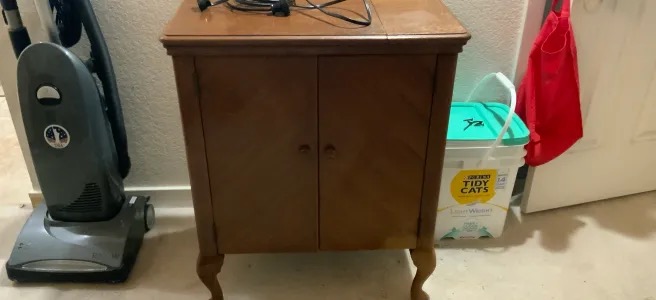
So, my recommendations are obviously quite variable. For someone with limited space whose primary work space is their communal living space or their bedroom, who will need to put everything away at the end of their sewing? I strongly recommend an old-school Singer in an attractive cabinet, because those were built for smaller houses, and with the intention that the lady of the house would close everything up when she was done sewing, when the kids came home from school or when it was time to make dinner, and they’re built specifically to be unobtrusive furniture you’re happy to have visible to guests. I’d also suggest a pretty picnic basket or other attractive, closeable container that can hold the work in progress. The deskier cabinets (the 42 and the 65) have drawer room for lots of tools, and so do the stools/chairs, which have lift-off lids to conceal attachments and stuff. The more table-like ones (basically every other 100% wood cabinet Singer made and can be found here) will need some additional tool storage. The 48, in the header image, can be a good compromise for smaller people. It has a LOT of storage, but the kneehole is very narrow and I don’t suggest using the knee lever.
If you also need that machine to be as close to an all-in-one that can sew everything from knits to sheers to canvas? I’m gonna steer you at either a Singer 500 or 503 Rocketeer (for those who REALLY like Mid-century modern) or a Singer 401 or 403, or a Pfaff 230 Automatic. And personally, I’ll steer you to the 403 and 503 first, because while they use cams (that you’re probably going to have to buy separately) to produce all those interesting stitches, that means they’re mechanically less prone to faults. The more that’s built in, the more likely something can go wrong, and the harder it is to fix.
If you don’t really need every stitch and its brother, but do need the ability to sew good buttonholes and install zippers, then any of Singer straight stitches is a good fit, with the buttonhole attachment. I tend to recommend the Singer 201 as one of smoothest, quietest machines ever made. But a post-1940 model 66 or 15 (because they have reverse) are also excellent choices. If you want one that can also be a portable and/or you have a need for serious speed? I’d encourage looking for a 301 that comes with a travel case, and a cabinet for it. Do note that if you go for a 301 and a cabinet, you will have to modify the cabinet by trimming an edge of the front support and installing a support cradle so it can be removed. (I have a tutorial coming on this.)
Portable is a caveat; a Featherweight is 11 pounds alone, 14-17 pounds in the case. Not laptop light, but luggable. A 301 is 16 pounds alone, and about 24 pounds in the case. I wouldn’t take either on a long hike, but there are also luggage dollies available.
And in this case, the major recommendation I have is buy the best cabinet you can find that you like the look of, in the best condition possible, and be willing to treat it like good furniture, so there will be polishing and waxing from time to time, and you’ll get a bit stroppy about coasters. The wood is more perishable than the machine heads (the mechanical part), and the cabinets were themselves expensive pieces of furniture. So while the sewing machine head was also expensive, those tended to be swapped out more often as new features became available. This is why it’s not uncommon to find a 1930s or 40s cabinet with a late 1950s sewing machine installed, and why there are more heads than cabinets. Singer was good at taking trade-ins.
While Singer refurbished and resold the Singer heads they took in trade as the equivalent of certified used, they literally sent any other manufacturer’s head to scrap metal recycling, which is one major reason there are millions more Singer heads than White Rotary, Kenmore, etc. I do LIKE Singers, and I tend to recommend them because they’re common and there’s a ton of documentation and many parts available, but the corporate practices left much to be desired, and I never suggest buying a new one.
Now the reason I’m not suggesting a modern new machine? They don’t fit in the nice, antique cabinets, and the new cabinets that are designed for them? Are not very pretty, not well made (they’re usually particle board), and they almost always require IKEA level assembly, but without even IKEA’s well designed instructions. Or you’re talking a custom build, which requires a furniture maker, and will almost certainly cost you more than even a top of line new machine, and will come with massive decision fatigue. At max, for an excellent quality vintage/antique cabinet and a excellent vintage/antique sewing machine, you’re talking well under $1000 in 2024 money.
And time. You are also talking time, because you will have to watch Facebook Marketplace, Craigslist and your local thrift/vintage shops for the cabinet you decide you want. Or pay major shipping costs for an eBay/Etsy cabinet, and hope that the shippers don’t treat FRAGILE as a Kick Me sign. I don’t recommend buying a whole cabinet on eBay/Etsy unless it’s local to you and you can pick it up.
And yes, it will fit in your car if you have a folding backseat. I have fit all of Singer’s classic cabinets in the back of my Mini Cooper. They’re petite cabinets. (If you don’t have a car, you’ll need Task Rabbit or similar.)
Now, if you do have a dedicated sewing space, and don’t want your living room being periodically taken over with a sewing project, but also want the ability to quickly sit down and sew a couple seams in a few spare minutes, then yes, you’re probably looking at wanting a modern machine with a good number of features, and an equivalent furniture set up, such as any Arrow cabinet offering. I strongly suggest a modern cabinet with a lift, either electric or pneumatic so you can get the bed of the machine level with your table (and can raise it when you need a free arm). This is just good ergonomics — having a machine where your arms are being held above the table will result eventually in repetitive stress injuries.
I don’t recommend those modern cabinets if you’re a renter or someone who moves a lot* — they’re heavy, and being particle board, they’re kind of fragile and easily damaged in transit. The vintage cabinets do move fine (wrap them in a blanket, of course, but they’re unlikely to break in un-repairable ways). But if you own your house and are planning to age in place, the Arrows are very good and will serve you well for many years. Just don’t expect to hand them down the way our grandparents handed down their machines and cabinets. I can show you what 70 year old particle board does with screws — it’s not pretty.
* With one exception; the Arrow Gidget tables (linked further down) are very renter friendly and are designed to be transported. But they have ZERO hide-ability when the machine is in the table. They do hide nicely in a closet or under a bed when not in use, though.
Okay, so, even that’s too much space to dedicate to sewing? Well, do you have room for a bookcase? Here’s where we’ll get a bit DIY and crafty — I recommend an IKEA IVAR shelf unit, one of the 31” wide by 12” deep by as tall as you can go, with doors, and the IVAR desk unit that folds down. Your sewing machine will be stored on a shelf behind the desk or the doors, along with whatever you’re working on. This fits well in a corner of a room, and can be totally unobtrusive. You’ll also want a chair you can move into that space, preferably a firmer office type. Nothing overpadded, but also nothing hard and unsupportive. Ikea Ivars also do move well, so they’re good for renters willing to patch 1-2 holes in a wall (for the earthquake mount, which you can’t skip).
As for the machine you pick, you can go vintage or modern on this one, you’re just looking for smaller. For vintage, I’d say a 301 in a case (long-bed if possible, but they are rarer), or a Singer 99 or a Singer 185 in a base (doesn’t HAVE to have the upper case, though the bentwood uppers are very nice; 99s and 185s are the same hardware, 185 is an updated body and a very pretty mint green instead of black.). You can get a folding card table, either vintage or reproduction for the 221 and 301; they’re about 3 feet on a side, and they make good cutting tables as well as sewing tables. For a modern, you should consider one of the smaller electronic Brothers or Baby Locks. (I’ll always suggest these two together because they’re almost identical machines. They use the same software, almost all of the same attachments, and they’re pretty interchangeable.) For Brother, I’d suggest an SE700 if you want to have some machine embroidery available (I used its predecessor and passed it on after a decade, still going strong), or a PQ1600 S if you’re looking at quilting or anything large. For BabyLock, I’d suggest a used Verve (I own one, it’s my backup robot and a rock-solid choice) or new Jubilant or Presto 2 or a Baby Lock Jazz 2 for quilters. As of April 2025, Baby Lock has one new sewing + embroidery machine priced at $999, the Aurora, but the SE700 is a much better deal.
YES, modern machines can multiple layers of denim. Use the right needle (at least a 100/16, but 110/18 or 125/20 by preference) and go slow. Use a hump jumper to go over thick seams. You can assist when the machine is being cautious by turning the hand wheel manually. The machine doesn’t want to break so its tolerances are set cautiously.
Or a Featherweight, if you must.
You notice I don’t really mention the Featherweight? Yeah, I’m not a huge fan. I own one, got it for a couple hundred a few years ago. It’s cute, it’s pretty, and it sews fine (though it can be temperamental about tension, because that’s a nature of its beast). But it’s also tiny, a half-sized machine, and it feels cramped to sew with it, especially if you’re doing anything big like a dress or trousers. That quilters use it seems remarkable to me. It’s a fine machine for social sewing, if that’s your thing, and they’re desirable and collectible. But give me a 301 or a modern lightweight Brother or Babylock by preference.
Okay, need to go even smaller? Well, you’re looking only at true portables, which for vintage is the 301, the 221 Featherweight, or of more recent vintage, a Bernina Nova 900*. For moderns, I’d probably point you at a Janome DC1050, or a Brother BM3850, or the Brother SE700 above. They’re relatively inexpensive, they’re electronic but simple, and they’re lightweight, which matters, because your time is going to be reduced because you have to put it away and set it back up every time you sew.
*Note: I don’t often recommend Berninas. I find them unpleasantly noisy, and also I don’t think their quality excuses their expense, and it definitely does not excuse their sales model — they take the dealership model to its nastiest, snobbiest extreme in every metro I’ve lived in, so it’s not just my local. They’re also bad team players in that once you’re in the Bernina system, you’re stuck with their proprietary attachments and feet. If you have a Janome/Babylock/Brother/newer Singer/Pfaff, they all use snap on and low shank feet, you can still use all of your feet and a good number of attachments (other than the embroidery attachments that came with the machine). Bernina feet are for Berninas only, and can only be bought at a Bernina shop. But some people swear by them.
The one thing I will tell you is a must for a modern machine? One-step buttonholes. It needs to have at LEAST one available; 3-5 is normal. Do NOT accept a machine that has a four step button hole. You will not be happy with those buttonholes and that will make you unhappy with any garment you sew, and with the machine. Because look, a vintage can do a one step buttonhole by attaching a little brick to the needle bar and figuring out the settings. You can practice your buttonholes for a couple hours on a piece of cloth and forever know what you want. If vintages can do one-step buttonholes for the cost of a fairly shallow learning curve and a couple minutes to attach the buttonholer, your modern machine should 100% be doing one-step buttonholes.
But if you’re also really tight and focused on a portable only, I’d also point you at home organization and maybe a decluttering service, because ergonomically, portable machines used on whatever table you have are really rough on a body, because you’re going to spend several hours per garment/quilt/fabric object with this machine. You will not sew if it hurts. Let me repeat that: You will NOT sew if sewing hurts. A flatbed that’s flush with a cabinet supports your hands and arms, while a portable puts your arms and elbows at an unsupported high angle. It matters less when you’re 20, but once you hit 40, that’s gonna hurt. If you have ANY choice at all, sew with a table and with the machine recessed down inside to make a flatbed.
And that does come with a cost. The very cheapest modern pairing is any smaller sewing machine and a folding, Arrow Gidget sewing table and that’s going to start around $450 for the pair and can go significantly higher. I have one of the black version (they call it the Heavyweight) to go with my Featherweight (or other small machine) and it’s fine. It’s not the most comfortable sewing I’ve ever done, but it’s also 100% not the most uncomfortable, either, and it is solidly pro-ergonomic.
So do keep in mind that finding a vintage machine in one of the petite cabinets can be as little as $25 and the effort to go pick it up and rehab it. If space is a true premium, strongly consider a vintage in a petite cabinet.
And… I guess if this isn’t enough, you can hit me up and get some of my time for a personal consultation. Let’s say $50 for up to 2 hours.
Next up: all the sewing stuff that’s not a sewing machine and a space to use it.

Be First to Comment