
Originally a Twitter thread in 2019. Some additions and clean-up, and updating.
I keep lists of my DNF (did not finish) reads. I noted a pattern forming in the last three months and it’s got me thinking, but as usual, please consider it a workshop piece, a first draft.
We’re creatives. We tend to be well tuned to the feelings of others. For the past decade, there’s been a whole WHACK of a lot of despair, pain, frustration, war, trauma and general hardship. That gets into our heads and our work.
Creative work is a viral vector for evoking emotional states. We can just as easily spread despair as hope. It’s WHY we have to be aware of our emotional states and how we’re using our creativity.
So Most Critically, before we get into the mechanics of working with and through our creativity and emotional and behavioral health…
First, if you ARE depressed/anxious, you need therapy. There’s a good chance you need medication. If you’re in the US, I know that both of these can be difficult to access, but they need to be a priority. You’ve already tried toughing it out, and that doesn’t work. Group therapy and online therapy are perfectly good for therapy. You just have to commit to something.
If you’re not in the US, there’s a far better chance you’ve got better medical and mental health care than most Usians. Please take advantage of it. I know that time for you is also a limited resource, but the sooner you start, the faster you’ll feel better, too.
It takes 2-4 weeks for many meds to kick in. It takes about 3-5 therapy sessions to learn how to therapy, and how to do the homework, and to make sure you’ve got a good therapist fit. Therapy and meds are not an instant fix. If you make the call in the spring, plan for therapy to really be working by about Halloween, not Labor Day.
I’m A therapist. I’m not your therapist. This is a general document, not a specific plan for anyone, nor aimed at anyone. I notice trends and patterns. I can write about behavioral generalities and how trauma survivors usually work, but I can’t address your specifics.
You get to set your own boundaries, but in general, any therapist can tell you that if you let the anxiety/depression/insomnia/trauma (ADIT) set the boundaries, you’re not going anywhere or getting better, because ADIT is selfish and wants all your attention for itself.
Therapy will get uncomfortable, and will require you to move outside the comfort zones ADIT has erected. (This is not the same as “getting worse to get better”. That’s abusive therapy, and not in scope here.) Good therapy is a gradual widening of your comfort zones and boundaries.
And last of the prefaces, it is 100% okay to write to process. It’s 100% okay to write as PRE-process, when you’re not ready to work the hard trauma underneath. But that writing is not pro-work, it’s not for publication or shopping.
What I’ve been noticing over the past few months, especially in indie/self published work, is fiction as a substitute for processing and therapy. I first hit a run of it in romance, then in fantasy. Since Did Not Finish does affect how well someone gets paid, this is equally a mental health and financial matter.
This is going to sound harsh, but I’m stating this because I WANT lots of successful writing careers: Your novels are not the place to process trauma and depression. Your readers are not your therapists. If you traumatize them, they will stop reading.
I’m not saying you can’t write tragedy. I’m not saying you can’t address difficult situations. I’m not saying you can’t pull from your own experience.
What I am saying is you have to process your ADIT before you can turn it into creative fuel. If you throw your raw pain into your work, you will feel so protective of that work that you cannot bear criticism of it, and it will add to your own trauma.
(I personally would apply this to beta-readers, too. Give all the trigger warnings, give yourself weeks or months of emotional distance before you hand off a manuscript, recognize that there’s a difference between journal and rough draft.)
An example: The first 6 chapters of HP and P/S Stone make it fundamentally clear that Harry is an abused child. He’s neglected, he’s emotionally and educationally abused, and physically bullied. But there’s a lot of other story in those chapters, and we see Harry’s spark.
There are very good reasons we don’t have the first draft of that story, and at least one of them is probably that it was just too raw, and lacked the comic and fantasy elements that drew the reader in and helped create emotional resilience for both the reader and Harry.
2nd example: Katniss Everdeen, in her first chapters, is also neglected and abused – by her government, her region, her intimates. Her situation is also horrific, but from the first, we see that she’s the heroine of her own story. She would reject the idea of her victimhood.
Katniss doesn’t have a lot of choices due to her circumstances, but she makes the most of the ones she has, and she pushes the envelope of her own agency as hard as she can. She is deeply proactive, not reactive, which helps her be compelling.
3rd example (Visual media, a what not to do): 2nd season of The Handmaid’s Tale. It’s got a reputation for being trauma porn, because there’s so little agency on display. Everyone (we care about) keeps getting forced into worse situations. It seems there’s no way out.
It gives very little hope, and not even much resistance: the moments of agency tend to be destructive and/or self-destructive, actions of despair rather than work towards a goal, and every action of resistance is met with worse consequences.
If Harry had been beaten into the grey automaton that the Dursleys wanted, if Katniss had given up even her scraps of agency, they wouldn’t have been compelling characters. A world that starts with unrelenting suffering without flashes of agency and resistance is a sadistic world.
It attracts sadistic readers, and often does not evoke empathy or identification with the protagonist. Those sparks of autonomy and agency are often subsequent draft — they’re foreshadowing. They exist as route markers to guide the reader through the dark.
It’s especially important when we write characters and stories to be mindful that the people who will eventually pay us for our work are, at least in part, looking for hope and escape. They’re struck in the dystopia called Reality, too. The most important thing we can model is resilience.
If for no other reason than the resilience we model is the resilience we ourselves can use. After all: our very first audience is ourself. Our stories have to entertain us first, and keep our interest, and provide us with emotional resonance.
When we use our first drafts as our outlet to process our own trauma, what we’re doing is not so much processing as turning it into an open wound that we then intentionally expose to what’s already an emotionally difficult process: editorial and publication.
If you need pure emotional validation for your first draft, you need to select a single person who will give you nothing but positive regard and praise for your effort. That person is your alpha reader. TELL THIS PERSON you need only validation. And don’t ask them for critique.
Then you have to sit on your work for a while until it’s no longer a sink for your emotional process. You will have to grow some distance from that draft. If you don’t, you’ll get defensive about it, and you will spend a ton of emotional energy justifying and defending down to your grammatical errors.
(Which you will make, by the way. And typos. Everyone does.)
Your beta readers, your agent, your editor, and your audience will not appreciate your defensiveness. It will get old, and you will lose them. Without diminishing the creative side at all, the idea behind writing fiction – especially genre fiction – is to sell it. It’s work. You have to be professional.
Which is why it’s so necessary to work out trauma in other venues before exposing it. A dirty secret: most writers who have endured trauma probably have a trunk novel/roman a clef that’s a very lightly fictionalized and romanticized version of their own pain.
Narrative therapy is massively useful, one of the best ways to deal with trauma without re-traumatizing yourself. Writing the story of what happened and making it a better story is totally valid and it may be what rescues your soul.
But that trauma needs to stay close to home, because it is most powerful for you, and to you. Why? Because the people who *don’t* know it’s your story will not treat it with the gentleness you deserve, and because your story isn’t just yours.
There’s a reason almost every work of fiction – and most biopics/based on a true story – have the tag line in the small print: Any resemblance to actual persons, living or dead, or actual events is purely coincidental.
It’s not just a liability issue.
The lightly fictionalized roman a clef uses your family, friends, bullies, teachers and passerby who wander in. If they’re jerks, there’s a good chance they’ll decide to sue you. Or make your life miserable.
Plus, most of us are sensitive to what others feel, so we’ll waste time worrying what someone is thinking but is too polite to say. You have STORIES TO WRITE. You don’t have time for that kind of emotional quagmire.
There may come a day when you are ready to mine your processed trauma. You’ll know that day has come when you can hand that story to your worst enemy, shrug off the mean things they say about it, and take the valid criticism. Until then? You’re not ready.
And if reading it puts you back in the trauma, then you have not yet processed it. It’s just sitting there, like a land mine waiting to blow up, and waiting for you to be so desperate for validation of your trauma that you decide to plow that field and hope you don’t step on it.
Yeah, ADIT sucks. Just because it’s not easily visible doesn’t make it any less of an injury. You have to use your tools to protect yourself from making it worse while it heals. One of those tools is your drafts folder. (The others are therapy, meds, distance and time.)
Okay: don’t write your trauma as process. Not for others, but for your own sake.
Next: Write Something.
Wait, you just said not to write your trauma —
Yeah. Have you ever looked at Goya’s The Disasters of War? They’re a series of prints based on drawings he made during the Peninsular War, as reactions to the ongoing social trauma caused by Bonaparte and the Bourbon monarchy.
https://en.m.wikipedia.org/wiki/The_Disasters_of_War Content warning for the Wikipedia page: pen and ink images of scenes of war, destruction, death, pillage and sexual assault.
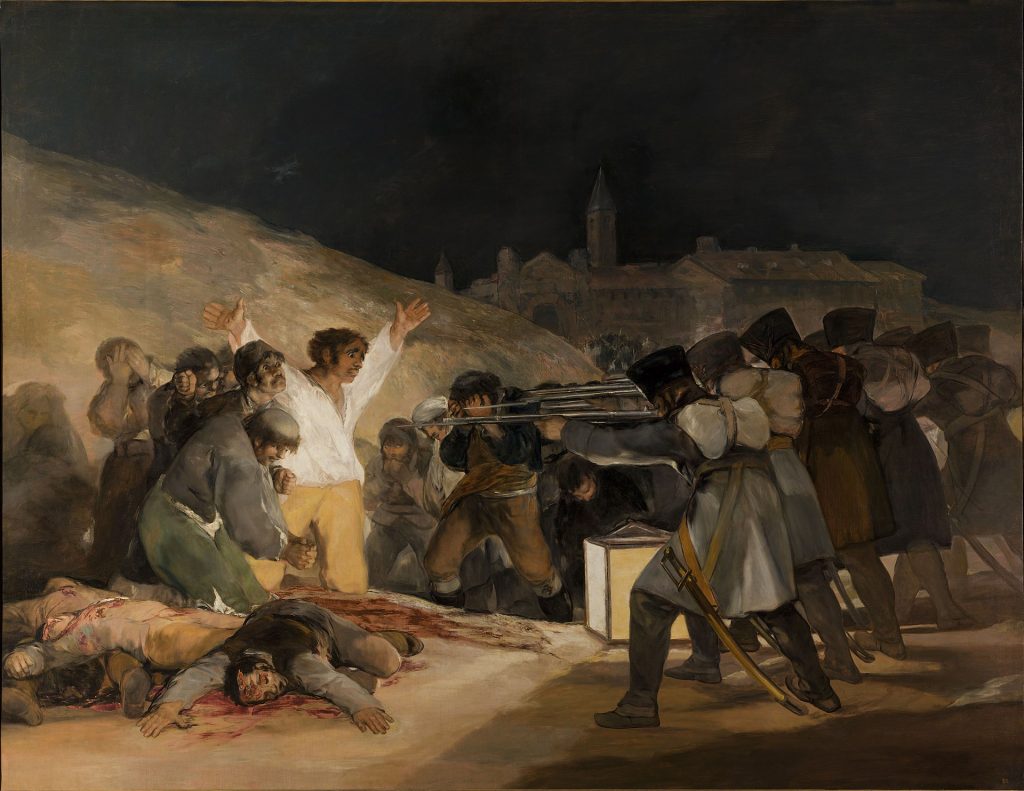
Goya was a court painter to the Spanish monarch, and his work from that period is perhaps the first photojournalism (before photography) of invasion, rebellion, famine and civil war.
He used the trauma he lived through to ensure that people didn’t forget, and to tell the stories that were being lost. Goya was amongst the living, and knew he had to be the advocate for the ones who could not speak.
Did his art help him process the trauma he was enduring? Probably. But it also gave him a focus on something other than his own pain. It was a means of distancing himself from the horror by capturing it in vignettes. Mediating our trauma through a video or picture or writing it down does provide distance and it’s a healthy distance if we’re mindful about it. Goya’s wasn’t complete distance – the Peninsular War was a horrific war.
When we can’t directly manage the effects of trauma that we’re feeling, we can displace it and distract from it. It’s sort of the same principle as re-reading/watching our favorite comfort book: we seek a dose of positive associations to get ourselves through the pain.
Distraction is a valid coping method, especially while we’re working through the trauma behind us. For those of us who tell stories, telling ourselves a story that is not about ourselves is a means of doing the emotional work from another direction.
Personal example: my relationship with my father is probably closest to Quin’s relationship with Reginal Tiwendar, and Cedri’s with his father. In the early drafts of Rebellion, Quin was just permanently estranged from his father, and Quin didn’t talk much about it.
Writing Quin gave me a way to examine the toxicity in isolation, without my personal complexities getting in the way. While I will never get the ending I gave Quin, the long years of thinking through Quin and Reginal helped me equip myself for dealing with my father.
Cedri effectively had my reality — placed in a hostile place, forced to choose his own life or the approval of his father, and putting faith in himself instead of investing it in the system that would ultimately kill him.
Did I run away from my abusive parent? Yep. Did it come with poverty? Yep. Did I rebuild myself and a life for myself? Yes. That mostly ends my resemblance to Quin and Ced. But Quin (and Bran, Ced and Lin, and Rien) let me think about the functions and systems of dysfunctional families in atomized bites.
Often, when we are dealing with ADIT, we need to let our subconscious and our imaginations work through very narrow lenses. When we directly mine our trauma, we’re not being indirect enough, and we will either shy away from the truths we need to figure out, or we will go too deep into the injury we’ve suffered. We’ll re-expose those nerves and retraumatize ourselves.
Think of trauma work like marble sculpture: you need to carefully remove layers from the outside, sometimes in large chunks, but more often in fine detail work.
As creatives, it’s in our best interest to work through the narrow frame we define in fiction. Creatives use what we have, but our job is to remix it and rebuild it into resilience instead of injury.
So write something. If you know your subject matter is getting too close to your triggers, it’s okay to put it away or redefine it to a tight story that only uses one aspect of the trauma you’re carrying. (Trauma is multi-faceted. Always.)
Third: ADIT comes with focus issues. Sorry. Especially for those of us who grew up in deep or lasting trauma, having our attention spread thin is a survival skill. We’re always watching for the threat in the corner of our eye, so we learn to exist within an attention deficit.
Which means we run out of steam while working on large projects. Especially if that project is too close or too focused on the trauma we have not yet processed. Trauma survivor brains are VERY good at redirecting us from stuff that’s going to hurt us.
When our traumatized brain decides it doesn’t want to work on the novel we’ve got planned and refuses to give us words on it, it often has a good reason. And if we push it too hard, it will make us anxious and depressed to get us off the painful subject.
This is why it is most important to first process that trauma with a therapist, because what happens when we’re trying to mine our unprocessed trauma is writer’s block. In part, it’s ADIT being needy and greedy for our attention, but also because it reinforces our fears.
Many creatives (especially with trauma histories) are pretty sure any success we’ve had is luck, that we’re imposters, that the well of creativity is going to dry up and we’ll be revealed as the lazy slackers our worst mind tells us we are.
When our trauma throws us into depression or anxiety to keep us from strip-mining what we have not yet processed, it also reinforces our feelings of despair and worthlessness. What a cycle, huh? And it will keep getting worse if we try to brute-force creativity.
So… when we’re having issues with focus, that’s not the time to be writing 100K words of novel. It’s the time to focus on short work. 500 words, 1000, 1500. If you draw, work on 1 page panels that tell a complete story. Work in fanfic. Use r/WritingPrompts for drabbles.
Blog posts. Twitter threads. (You didn’t think I just wrote these?) Or use the Goya model: write what you want to see happen, in short format. Write about the children leading their own rebellion. About women taking over polling places. About the strike or protest that changes everything.
Write your own resilience. Write your own hope. Maybe it’s pure wish fulfillment, and you’re going to have to give it away on your blog, but the hope you build for yourself can become a viral vector. We humans are more alike than not: what helps you feel better will help someone else.
Yeah, short fic has a limited market. That’s okay. The craft of writing shorts does in fact translate to writing novel scenes. Shorts help you learn to refocus frame within a novel as needed. That’s why working on them is worth the effort.
Plus, the psychological benefit of being able to sit down and finish something on a limited attention span. Shorts are a way to tell your ADIT to go fuck itself.
Remember: Hamilton started with one song, and it took a long time to become two songs. It’s 100% okay to have a collection of short stories that you post to your blog or Patreon, that you shop on a casual basis. Especially while you’re doing ADIT work.
Alternately, diving deep into the flow of writing can be a way of avoiding both reality and the cognitive work necessary. The story will be there even if you don’t get 50K words written over a long weekend. It’s not a limited time offer.
4th: Don’t stop writing.
It matters, if only because our imaginations are our first tool for learning how to cope with something. It’s why we can learn from watching a YouTube video, or practice something from instructions and not fail totally.
For creative writers? Turning emotions into stories is how we learn to process our own stories. But the reverse is also true: when you write unprocessed trauma, or from the depths of depression or anxiety, it shows far more than you want it to show.
The old canard about the Great American Unpublished Novel mostly being by and about middle-aged white academics in faltering marriages is… those men processing emotions they won’t talk about. In 1st draft.
It’s a sad trope because it recognizes how a specific subset of people fail to process their emotional issues. The reason it gets (deservedly) mocked is because it’s self-aggrandizing and self-delusional. It’s middle aged white guys thinking they are the only ones who count. And it’s just tropey — men will do anything to avoid therapy, including writing a novel.
But think about your favorite comfort book, the one that brings you solace. That book exists because someone did imagine past and through their emotional process to build something that resonates. And they couldn’t have done it without the emotional processing work.
Yours will be that book for someone else, but the processing work comes first.
I love you all.
Go to therapy.
And go write.
You’ll be better for both.

Be First to Comment